
Celiac College Guide
Written By: Kelsey Chadwick, MS RDN LDN
Whether you’ve had celiac for a while and are heading off to college or are newly diagnosed, navigating college with celiac can be challenging. I’ve put together this guide to help you have the best experience. As someone who navigated college with celiac I know exactly how you feel. At times, I felt far from normal and longed to be able to eat a good slice of pizza after a night out with friends, but keep in mind this was 10 years ago and gluten-free options are a lot more readily available! I promise you can have an amazing college experience, even with celiac. These are my top recommendations in order to do so.
Accommodations on Campus
Most schools require that you register through the Office of Disability Services before you can be eligible for special dietary accommodations. I went to the University of New Hampshire and I did not do this. I will admit more often than not growing up I tried to distance myself from my celiac diagnosis and just be “normal.” Looking back what I really needed was a celiac community for support and a place to go for reliable information I could trust. I was lucky that UNH had a decent GF section at most of the dining halls which included a separate refrigerator with only GF products, a separate toaster and an app that allowed me to order pasta and a couple of other things ahead of time. If I could go back, I would absolutely contact my schools Office of Disability Services to see what other resources or accommodations are available.
Contact your school’s Office of Disability Services
Get a note from your doctor or GI doctor stating you have celiac disease (be sure to have your doctor explicity mention any of the accommodations you are requesting)
Fill out necessary forms
Accommodations May Include:
Appliances in your room such as microwave, fridge, air fryer, toaster and a kettle
Access to a community kitchen
Academic accommodations in case of getting glutened
Dorm close to a dining hall with GF options
Having a car on campus so you can get to the grocery store when needed
Some History Behind Getting Accommodations
In December 2012, there was a lawsuit filed against Lesley University because GF students were being denied accommodations for a GF medically necessary diet and they were unable to opt-out of the mandatory meal plan. The case went to the US Department of Justice and it was ruled that Lesley University must make reasonable accommodations for students. This case did not establish a law that all colleges and universities must adhere to, but it provides guidelines for other schools to follow.
Lesley University Agreed to the Following:
Provide gluten-free and allergen-free food options in its dining hall food lines in addition to its standard meal options
Allow students with known allergies to pre-order allergen-free meals
Display notices concerning food allergies and identify foods containing specific allergens
Train food service and university staff on food allergy-related issues
Provide a dedicated space in its main dining hall to store and prepare gluten-free and allergen-free foods
Work to retain vendors that offer food without allergens
Source: Beyond CeliacBefore You Begin Eating at the Dining Hall
Meet with Food Service Director and Dining Dietitian: This helps get a sense of how well the dining hall can accommodate a celiac safe GF diet. Check out this post on what a celiac safe GF diet is and share it with staff as needed. It is also helpful to have a connection if problems come up or for any future recommendations and changes that could be helpful for other celiac students or those with food allergies. Staff are usually very open to making helpful changes for students. Check in regularly, at least once a semester to review any changes in protocols, GF menu items or meet new staff members.
During my time at UNH, I had to do a project for one of my classes and I actually got to work with our Dining Dietitian. It was a really fun project and experience and I learned a lot! I was able to propose new ideas for labeling allergens in the dining hall, plus work on menus and some other behind the scenes things. Getting involved was a great way to meet staff and share positive changes for celiacs and those with food allergies. While this might not be possible for everyone, as this was a project for my nutrition degree, but see if there are other ways you can get involved like volunteering or even working at one of your dining halls. Connection is key.
Helpful Questions to Ask At the Meeting:
Where is the best place to go for gluten-free food?
Do any of the dining halls have a gluten-free section for students?
Are there other students eating gluten-free on campus?
Are you able to share the ingredients of dishes served so I can ensure they are gluten-free?
Do the kitchens have a dedicated section for gluten-free food preparation?
How do you prevent cross-contact in your kitchen?
Do you use any symbols to indicate which dishes are gluten-free or can be made gluten-free? Is this on cards in front of the dishes or a separate place like online menus?
Can I order a GF meal in advance?
Are there other students on campus eating GF that I can connect with?
Questions to Ask Dining Hall staff
This dish looks great – Can you tell me the ingredients in it?
Do you know if these French fries were cooked with the onion rings or chicken fingers? Or are they made in a separate fryer?
It looks like some pasta fell into the brown rice. Would you be able to serve me a spoonful of rice from a fresh batch?
Do you mind changing your gloves before you prepare my gluten-free sandwich?
Can you place my burger on a piece of aluminum foil before you put it on the grill top? I know you toast the buns on the grill, so this way my food will be protected.
Using a Shared Kitchen in Your Dorm or Apartment
Avoiding cross-contact in your shared kitchen is so, so important. Cross-contact by definition occurs when an allergen is unintentionally transferred from a food containing an allergen to a food that does not contain the allergen. Cooking does not reduce or eliminate the chances of a person with celiac (or a food allergy) having a reaction to the food eaten. Cross-contact can occur at restaurants, in schools, at home in the kitchen, at friends and family’s homes and during the growing, processing and manufacturing processes of foods.
Here Are A Few Examples of Cross-Contact:
Using the same utensil to serve gluten-containing pasta and gluten-free pasta
Picking croutons off a salad that is supposed to be prepared GF
Using the same toaster for gluten-containing bread and gluten-free bread
Using the same condiment jar (such as jelly or mayo) to make a gluten-containing sandwich and a gluten-free sandwich and dipping the knife back in
How to Avoid Cross-Contact
Below is a quick guide to what items you should not share and items you can share. There are lots of things online about what items you should and shouldn’t share and below I made this list airing on the side of caution. Unfortunately, not a lot of studies are done on cross-contact so a lot of information out there is outdated. I also encourage you to air on the side of caution especially when cooking in a dorm kitchen or with roommates who might not understand your need to avoid cross-contact. It is 100% possible to use a shared kitchen, but in the college setting everyone has different levels of “cleanliness.” You might get to your dorm kitchen and find crumbs everywhere and dirty pots on the stove. In cases like this you might feel more comfortable just using a microwave in your dorm and that’s totally okay! (See below for microwave meal ideas). On the other hand, you might feel more comfortable wiping down the shared dorm kitchen quickly and bringing your own pans to cook with. Keep these safe in your room so you know they are dedicated GF.
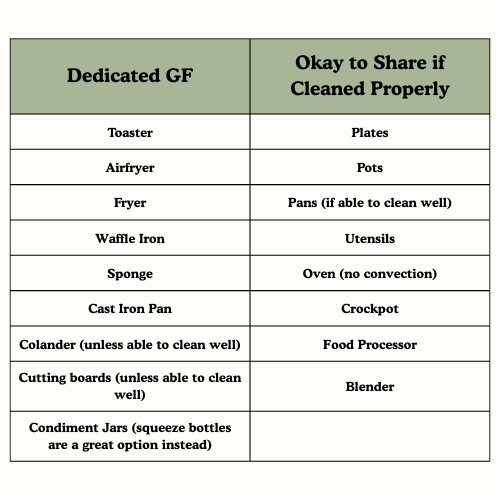
Depending on your dorm, you might have to bring all of your own kitchen items anyway which makes it easier with celiac because you know you are the only one using these items and storing them in your dorm. Make sure to inform your roommate though and formulate a plan if you plan to share kitchen items. The one item that is often always already available in a dorm kitchen is a toaster. These toaster bags are a great alternative if you cannot get a dedicated GF toaster.
Explaining Celiac to Roommates and Friends
I encourage you to have a conversation with your roommate(s) when you first move in about your celiac needs. Some things I think are important to share are a little bit about celiac disease, what cross-contact is and any items of yours that you want to keep 100% yours (such as snacks or any kitchen items). If you are planning on who’s bringing the fridge or microwave before move-in, then you might have to have this conversation via text or phone call before you move in. In the end share what you feel comfortable with and know that the earlier you share about your celiac diagnosis and needs, the easier it is to navigate.
In other social settings, you might end up sharing about your celiac diagnosis, if you aren’t able to have pizza at your club meeting or when you can’t order a beer with everyone (if you’re 21+) at the next hangout. At times like this I often just say something short and sweet like “I have celiac, which means I can’t eat any gluten, so I’ll just eat something later!” Sometimes people are genuinely curious what celiac is and in that case I might share a little bit more information and say something similar to this:
“Celiac disease is a genetic disease. When I eat gluten my body has an autoimmune response that damages part of my intestine. This creates loads of really uncomfortable and painful symptoms including nutrient malabsorption which really impacts my health. If I don’t follow a GF diet, which also includes avoiding any food that touches gluten-containing foods, it can lead to further serious health complications.”
Saying something like this is also super helpful when people don’t take celiac disease seriously or ask why you can’t have “just a little gluten.”
Share what YOU feel comfortable with roommates and friends. Having a support system that is knowledgeable and understands your specific needs really helps!
Eating Out at Restaurants
Everyone gets sick of the dining hall and heads out to the local restaurant every now and then. I recommend doing a little research at some point, maybe even before you arrive at school to find 1-2 restaurants that can offer celiac safe options. This can make things a lot easier when it’s actually time to go out to eat and you have a few safe options that you can suggest, instead of scrambling to find a place or read a ton of menus.
I also recommend using an allergen card. My favorite one’s are by Equal Eats. These are awesome for traveling to a place where they speak another language. You can also use the English one when dining out at school or at home. Tip: English is on the back of all of the cards in different languages. Pick a language card you think you might use in the future and save $ on just buying an English card. I print mine at home and laminate them so they stay in good shape.
Utilize the Find Me GF app. These apps can be a great place to start to find restaurants, but then I STRONGLY recommend doing your own research after this point. Never rely on reviews to determine if a restaurant is safe. You MUST investigate on your own. I have used this app many times and everyone’s knowledge of a celiac, safe diet and avoiding cross-contact is different. If someone leaves a review that says “they didn’t get sick” at a restaurant, it DOES NOT mean this restaurant is celiac safe. Every celiac reacts differently when they consume gluten and this is not a safe or reliable way to determine a restaurant’s safety for celiacs. You must speak with the restaurant staff directly about their protocols for preparing GF food for someone with celiac. Calling during off-peak hours is a great way to get answers. Check out this post for a list of questions to ask restaurant staff.
Unfortunately, there will be times where you might not be able to eat anything when dining out with friends. It’s a position most celiacs have probably been in before and it’s annoying and sad. Sometimes the only option is a lousy garden salad with oil and vinegar, while other times a restaurant might say they cannot safely make you a gluten-free meal. I encourage you to always pack snacks with you because you never know when this might happen and NEVER ever eat gluten just to fit in or make other people happy.
Dorm Room Meal Ideas
Breakfast
GF cereal with milk
Yogurt bowl – Greek yogurt, granola, chia seeds, berries & honey
Frozen breakfast sandwich (Rudi’s)
Frozen breakfast burrito (Amy’s)
Van’s frozen GF waffles with PB and mixed berries
Premade smoothie
Glutino English muffin with avocado and everything but the bagel seasoning
Lunch & Dinner
Good to Go cups
Salad kit with pre-made grilled chicken
Microwave rice, frozen veggies and pre-made grilled chicken topped with soy sauce
Kevin’s Natural Foods (ready to eat in 5 min)
Mission GF wrap with hummus, salad kit and pre-made grilled chicken
Chicken salad sandwich with potato chips
GF frozen pizza (Against the Grain, Good & Gather, Freschetta, Banza, Caulipower)
Shelf Stable Snack Ideas
Trail mix
Popcorn
GF muffin
Dates with PB and chocolate chips
Apple or banana with a nut butter
Frozen Snack Ideas
Refrigerated Snack Ideas
GF crackers with hummus (GF crackers: Glutino, Crunchmaster, Blue Diamond Nut Thins, Simple Mills, Maine Crisp)
GF crackers with cheese
Yogurt with GF granola and fruit
Chips and salsa
Cheese stick and fruit
GF pretzels with hummus or GF dip (GF pretzel brands: Quinn, Snyder’s, glutino, from the ground up, good health, Schar, UNREAL, Savor By Susie’s, Gratify, Fit Joy, Snack Factory)

A Note on Alcohol For Those Who Are 21+
Alcoholic beverages are either fermented or distilled.
Fermented Alcohol: it may contain protein from the starting materials that provided the starch or sugar. Whether a fermented alcohol is considered free of gluten protein depends upon the starting material.
Distilled Alcohol: proteins from the starting materials that provided the starch or sugar are removed. Distilled spirits are considered to be free of gluten protein even if the starting material for the alcohol is wheat, barley, or rye. If a gluten-containing ingredient is added in after distillation it is NOT gluten-free.
List of GF Distilled Alcohols:
Brandy (distilled from wine)
Gin (distilled from malted barley, rye and juniper berries)
Rum (distilled from sugar cane)
Tequila (distilled from agave plant)
Vodka (distilled from corn, potato and wheat)
Irish whiskey (distilled from barley & other grains)
Bourbon whiskey (distilled from corn & other grains)
Rye whiskey (distilled from rye & other grains)
Scotch whiskey (distilled from malted barley & other grains)
Alcohols that CONTAIN GLUTEN (this is NOT a complete list):
Beer (even gluten-reduced beer)
Mike’s Hard Lemonade
Twisted Tea
Beer and other malted beverages (ale, porter, stout)
Sake/rice wine made with barley malt
Flavored hard cider containing malt
Flavored hard lemonade containing malt
Flavored wine coolers containing malt or hydrolyzed wheat protein
If you’d like personalized support beyond general advice, I offer virtual celiac nutrition counseling.
You can learn more about the different services I offer here.

Meet the Author
Kelsey is a Registered and Licensed dietitian in the Greater Boston Area. Kelsey was diagnosed with celiac disease in 2011 which led her to become a Registered Dietitian with a goal of helping others navigate the crazy nutrition world. When she’s not seeing clients or writing blog posts, you will probably find her hanging out with her family or traveling to a new destination!
