
Navigating Coffee Shops as a Celiac ☕️
Written By: Kelsey Chadwick, MS RDN LDN
I think about coffee more than I’d like to admit. I drink two to three cups per day typically and it’s one of my favorite parts of the day. I’m not a fan of milk in my coffee, but I do love a good flavor. Pistachio is my favorite. I enjoy supporting local coffee shops and try to get coffee beans locally when possible. Lot’s of coffee shops use syrups to flavor their coffees and they’re also a fun way to make flavorful coffees at home, but it can be hard to determine which ones are gluten free. I’ve put together this guide to help you find gluten-free syrups and gluten-free plant-based milks.
The following syrups offer gluten-free options. Please always check the label, as ingredients and protocols can change at any time!
Monin
Monin states on their website that “Our Premium Syrups, including Sugar Free, Concentrates, Organics, Natural Zero Flavorings, and Sweeteners as well as our Fruit Purées, Sauces, and Fruit Smoothie are Gluten Free.” Be sure to check the label for any changes.
Torani
According to the Torani Gluten Free Table on their website, all of their syrups are gluten-free EXCEPT the following:
Sugar Free Classic Caramel 375 ml
Sugar Free S’Mores 375 ml
Sugar Free S’Mores
Classic Caramel 375 ml
Sugar Free S’Mores 750 ml
Toasted Marshmallow
Jordan’s Skinny Syrups
According to their website, all of the following products are gluten free:
Skinny Syrups
Skinny Mixes
Naturally Sweetened Skinny Syrups
Naturally Sweetened Margarita Mixes
Skinny Sauces
Lemonade + Tea Concentrates
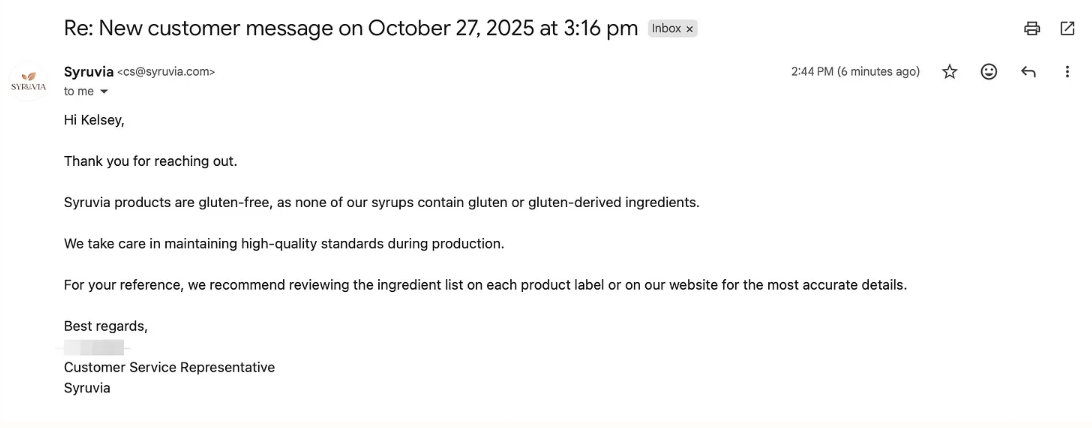
Syruvia
Based on their website it appeared that all of their products are gluten-free and so I reached out just to confirm and they ARE all gluten-free!
What About Plant-Based Milks?
Plant-based milks have been all the rage for many years now and for good reason. They are a great alternative to anyone who is lactose intolerant or has to follow a dairy free diet. However, they can be tricky to navigate as a celiac, especially oat milks. I took a deep dive into the more popular plant-based milks to share which ones are safe for celiacs.
MALK — Certified gluten-free (NSF)
MALK is a newer one I came across this past year and I fell in love with it. It’s certified gluten-free by NSF and has just a few ingredients. MALK makes almond milks, coconut milk, soy milk, cashew milk, coconut creamers, a seasonal Holiday Nog Almond Milk and shelf-stable options for almond and oat milk. And unlike other brands, they use gluten-free oats in their oat milk, making it safe for celiacs. You can check out their products here.
Oatly — Certified GF in the United States (GFCO)
I found the following information on their website under FAQs:
“When it comes to gluten, it depends on where you live. In the US and Canada, our products are made from certified gluten-free oats and (consequently) labelled as gluten-free. In Europe and Asia, however, our products can contain a small amount of gluten. So, although it may not be much gluten at all - they cannot, of course, be classified as completely gluten-free. If you’re ever unsure if Oatly is gluten-free or not in your country, check the labeling on the package.”
“Our US products are certified gluten-free and made without tree nuts, peanuts, dairy, and egg. Based on the US FALCPA (Food Allergen Labeling and Consumer Protection Act) and the FASTER Act (Food Allergy Safety, Treatment, Education and Research Act), they are safe for people with allergies to the top nine allergens (milk, eggs, fish, shellfish, tree nuts, peanuts, gluten and soy and sesame).”
Currently, all Oatly products in the United States are gluten-free and are celiac safe, including their oat milk products.
Chobani Creamers
Chobani creamers are gluten-free. You can find their list of flavors here. Chobani states the following on their website:
“We've been on a mission since day one to provide better food for more people. Most Chobani® products, with the exception of a few varieties of our Chobani® products with sidecar mix-ins, are gluten-free. The FDA defines “gluten-free” as containing no more than 20 ppm of gluten.” You can find this statement here.
Silk — Oatmilk is NOT celiac safe
On their website Silk states: “All Silk products are gluten-free and can be suitable for people with gluten allergies. We have allergen protocols in place to prevent and detect contamination by gluten or gluten components. Of course, those with allergies should always consult a doctor before introducing a new food.” You can find this on their FAQ page here.
They also state that “Yes, Silk Oatmilk is gluten-free,” BUT as a celiac I would NOT consume this product. In order for oats to be considered celiac-safe the product must either be certified gluten-free or list gluten-free oats in the ingredient list. Silk oat milk is not certified gluten-free and they do not list gluten-free oats in the ingredient list. This would also be the case for Silk Oat creamers as well. You can read my post on oats here.
These are the ingredients list for Silk Original Oatmilk on their website:
Oatmilk (Water, Oat Concentrate), Contains 2% or Less of: Sunflower Oil, Vitamin and Mineral Blend (Calcium Carbonate, Vitamin E Acetate, Vitamin A Palmitate, Vitamin D2, Vitamin B12), Dipotassium Phosphate, Sea Salt, Gellan Gum, Locust Bean Gum, Ascorbic Acid (Vitamin C To Protect Freshness), Natural Flavor.
“We work hard to keep the information on this website up-to-date, but please check the label on your product for the most current ingredient statement.”
Califia — Oatmilk is NOT celiac safe
On their website Califia states “Yes, our products, with the exception of our Organic Oatmilk, are gluten free according to FDA guidelines, which require gluten free products to contain less than 20ppm of gluten.” It’s unclear if Califia does any in-house or third-party testing for their products to contain less than 20ppm of gluten, but this isn’t a requirement if there are non gluten-
They also provide this statement in regards to other allergens present in their facility:
“Our PET plastic bottle products are made in a facility that processes tree nuts, and our laminated carton products are processed in a facility that processes dairy, tree nuts and soy. Califia Farms has Food Safety protocols in place to eliminate the risk for cross-contamination at our production facilities.
Califia Farms has a thorough allergen program in place that is properly validated and verified by independent third-party analysis. All equipment is tested following cleaning using methods and procedures that are approved for use in food plants to verify allergen status.”
What About Cross-Contact at Coffee Shops?
Most coffee shops get lots of traffic, especially in the morning or on the weekends. Despite this, it’s still important to ask about cross-contact. If you’re getting an espresso, Americano, a long black or anything without a syrup or milk then you should be good to go. However, if you’re ordering a latte or anything with steamed milk, ask staff to clean the milk frothing pitcher or use a fresh one that’s ready to go. In addition to this, always ask about any syrups you want to add to your coffee and have them double check the ingredients, which might change at any time.
Happy coffee drinking!
If you’d like personalized support beyond general advice, I offer virtual celiac nutrition counseling.
You can learn more about the different services I offer here.

Meet the Author
Kelsey is a Registered and Licensed dietitian in the Greater Boston Area. Kelsey was diagnosed with celiac disease in 2011 which led her to become a Registered Dietitian with a goal of helping others navigate the crazy nutrition world. When she’s not seeing clients or writing blog posts, you will probably find her hanging out with her family or traveling to a new destination!
