
Reading Labels with Celiac Disease
Written By: Kelsey Chadwick, MS RDN LDN
Oh the joys of being gluten-free and reading the food label on every item you pick up at the grocery store. Everyone has an individual preference and level of comfortability when it comes to gluten-free grocery shopping. My goal is to help you feel confident reading labels and also expand what you are able to purchase at the store.
It is extremely important to know you do NOT need to buy only products that are certified gluten-free or even labeled ‘gluten-free.’ There are lots of products out there that are actually gluten-free, but do not have a “gluten-free” label. These products can be anything like fresh fruits or vegetables to a jar of peanut butter or jam. “Gluten-free” is a voluntary claim that manufacturers may choose to use in the labeling of their foods. However, many companies do choose to add a ‘gluten-free’ label to their products. The FDA’s gluten-free food labeling rule specifies what the claim actually means on a food label. More on this in a minute. First, I want to share the first thing to do when looking at a product. Scan for a “gluten-free” claim which might be anywhere on the package. Even if it has a gluten-free label I recommend still checking the ingredient list. I’ve seen products incorrectly labeled before so you never know when this might happen. If you don’t see a gluten-free label anywhere you must always check the ingredient list to look for the following:
Initial things to look for on a label:
Wheat
Barley
Rye
Malt
Brewer’s Yeast
Oats (Unless they are specifically labeled gluten-free in the ingredient list)
Ingredient List: look for wheat, rye, barley, malt, triticale, brewer’s yeast and oats
Contains: This statement must identify any of the “Big Nine,” that are present in the product. The “Big Eight” are milk, egg, fish, shellfish, tree nuts, wheat, peanuts, soybeans (soy or soya) and sesame. The top nine allergens must be disclosed under the Food Allergen Consumer Protection Act (FALCPA). Barley, Rye and Gluten are not included, so you must look at the ingredients list to see if they are in a product. You can read more about FALCPA here.
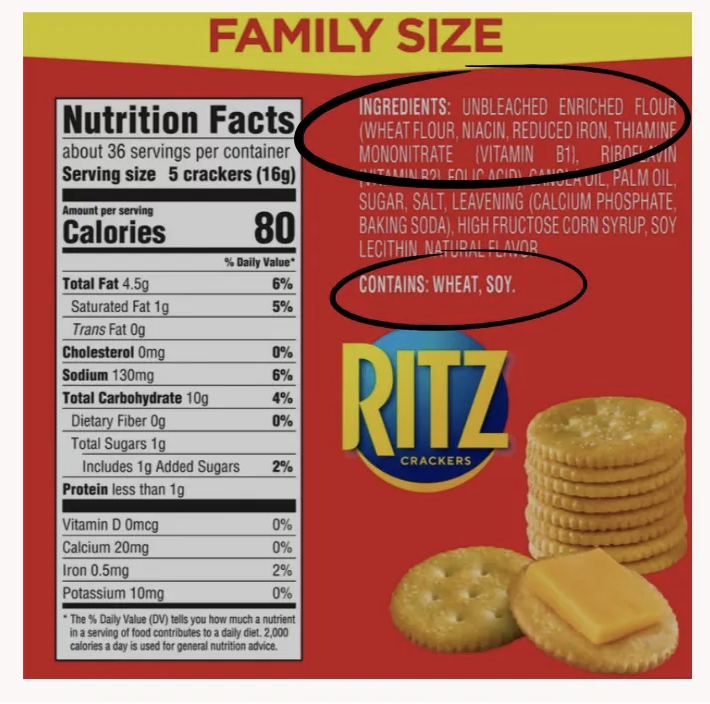
Below is an example of needing to read the ingredient list because barley and rye will not be listed in the “contains statement”
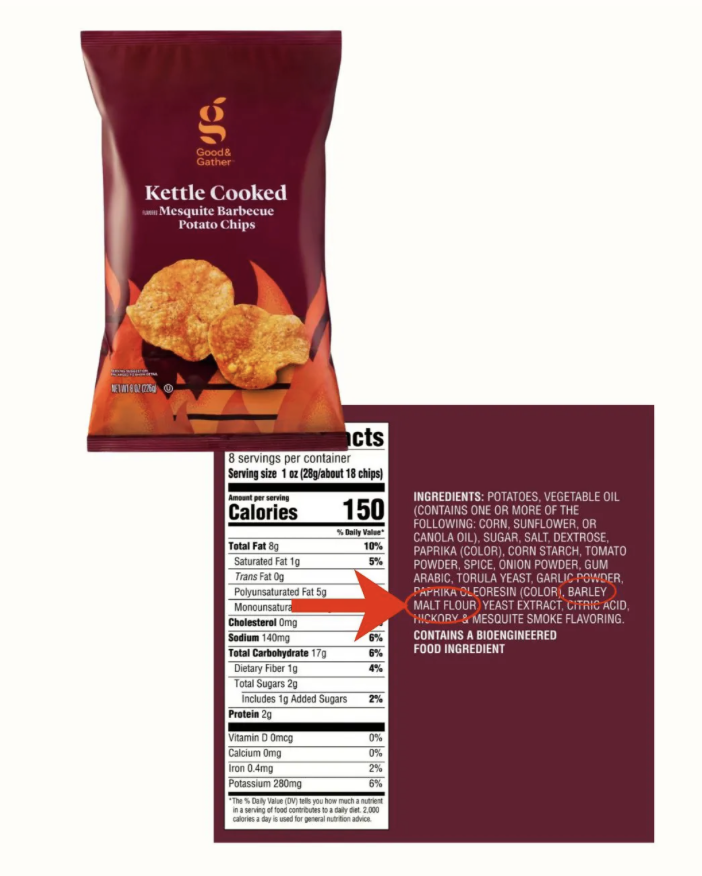
Other ingredients to look for that contain gluten (in addition to wheat, barley, rye, malt, brewer’s yeast and oats)
Barley malt extract
Batter, breading
Bran
Broth, bouillon
Bulgur
Couscous
Dextrin if made from wheat
Durum
Einkorn
Emmer
Farina
Farro
Graham flour
Kamut
Malt flavoring (If malt flavoring appears of the ingredient list, assume it is barley unless otherwise stated on the label)
Orzo
Semolina
Spelt
FDA Labeling Rule
Manufacturers that label their foods as free of gluten are responsible for using the claim in an accurate and not misleading manner, and for complying with all requirements established by the regulation and enforced by the FDA. The rule specifies, among other criteria, that any foods that carry the label “gluten-free,” “no gluten,” “free of gluten,” or “without gluten” must contain less than 20 parts per million (ppm) of gluten. There were no U.S. standards or definitions for the food industry to use in labeling products as “gluten-free,” before the FDA issued this regulation in 2013.
Note: PPM is a way of expressing very dilute concentrations of substances. Just as per cent means out of a hundred. PPM means parts per million or out of a million. Current research shows consuming a diet at 20 parts per million (ppm) is considered safe for those with celiac disease.
A Food Product Regulated by the FDA May be Labeled Gluten-Free If:
“It is inherently gluten-free, meaning it does NOT contain wheat, rye, barley, or their crossbred hybrids like triticale (a gluten-containing grain) OR
It does NOT contain an ingredient that is derived from a gluten-containing grain that has not been processed to remove gluten (e.g., wheat flour) OR
It does NOT contain an ingredient derived from a gluten-containing grain that has been processed to remove gluten (e.g., wheat starch), if the use of that ingredient results in the presence of 20 ppm or more gluten in the food
Also, any unavoidable presence of gluten in the food must be less than 20 ppm.”
Source: FDAFoods That Are Covered:
All FDA-regulated foods
Dietary supplements (vitamins, minerals, herbs, amino acids)
Imported food products that are subject to FDA regulations
Foods That Are NOT Covered:
Meat, poultry, and unshelled eggs (and any other products regulated by the USDA)
Distilled spirits & wines that contain 7% or more alcohol by volume
Malted beverages made with malted barley or hops
What About Manufacturers Compliance?
Once this regulation was put in place, manufactures had until August 2014 to bring their labels to compliance. Today, if a food that is labeled as “gluten-free” but fails to meet the requirements of the regulation it is subject to regulatory action by the FDA.
How Does the FDA Enforce the Label Requirements?
The FDA may perform food label reviews, follow-up on consumer and industry complaints, and analyze food samples. Consumers and manufacturers may report a complaint to an FDA Consumer Complaint Coordinator in the state where the food was purchased.
CAERS
AKA Center for Food Safety and Applied Nutrition’s Adverse Event Reporting System. Any complaints regarding an FDA-regulated food can also be made to an FDA Consumer Complaint Coordinator for the state where the food was purchased. Contact Info: 240-402-2405 or email, CAERS@cfsan.fda.gov
What to Include in Your Report:
The name, address, and phone number of the person or persons affected as well as for the person reporting the incident
Name of the doctor or hospital if emergency treatment was provided
A clear description of the problem. Describe the product as completely as possible, including any codes or identifying marks on the label or container
The name and address of the store where the product was purchased and the date of purchase
Is There a Symbol to Identify Foods that Meet the FDA Regulations?
No, the FDA states that consumers favor the label “gluten-free” to communicate that a food is free of gluten. Manufacturers are allowed to include a symbol as long as it is not misleading and is truthful.
Shared Facility Warnings
This a voluntary claim and is not required
If a product is labeled “gluten-free” and also states that it is made in the same facility as products containing wheat, it IS still safe to eat.
The “gluten-free” label means that the procedures in place to prevent cross-contact with gluten meet FDA standards.
For foods that are NOT labeled gluten free, you must investigate further. It is recommended to contact the manufacturer for more details about processing procedures including:
Is gluten used on the same belt/equipment?
Do you have a cleaning process between products
What are your procedures for preventing cross-contact?
What About Third Party Gluten-Free Certifications?
A few companies test products to ensure they are gluten-free. The following are certified gluten-free labels you might see:
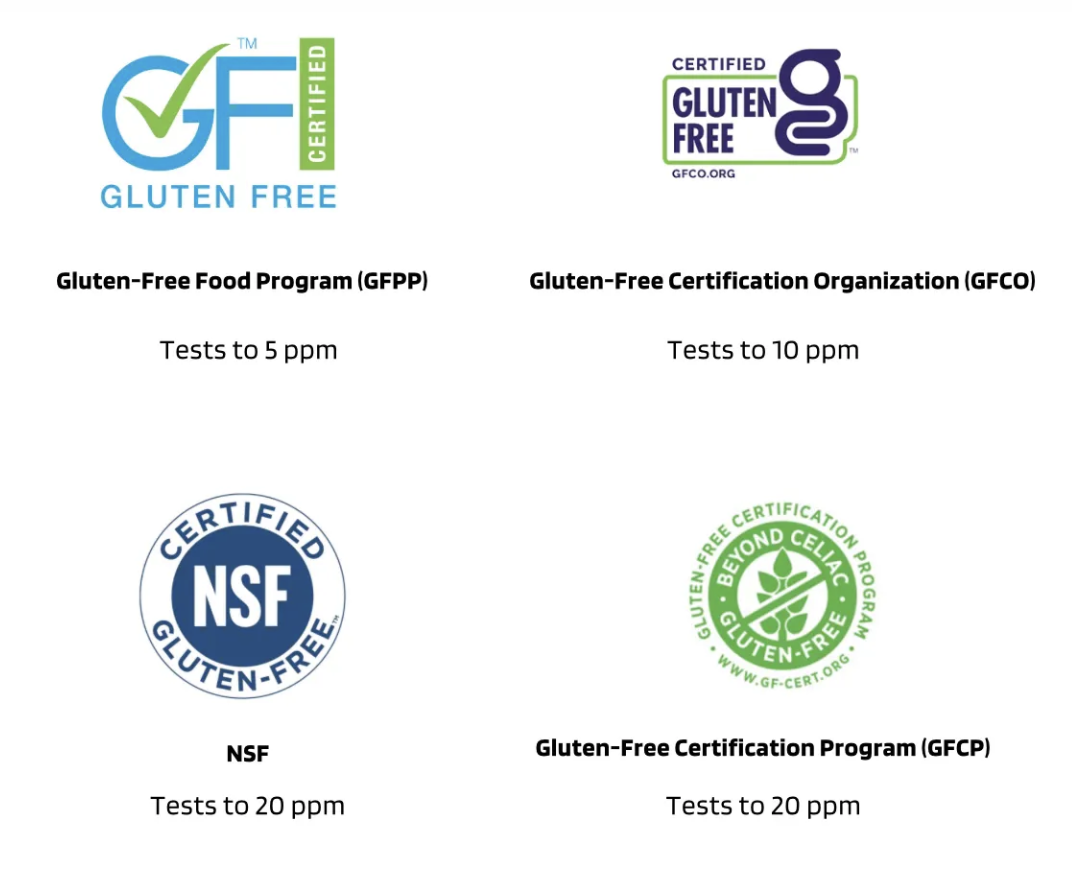
The following information is what I was able to find on each of these company’s websites regarding their practices.
Gluten-Free Food Program (GFPP)
Tests to 5 ppm
A leading provider of gluten-free certification services in the United States, Canada and worldwide since 2004 and is endorsed by the National Celiac Association.
Gluten-Free Certification Organization (GFCO)
Tests to 10 ppm
A program of the Gluten Intolerance Group (GIG) that operates as an independent, third-party certification program for gluten-free products. The program is not a requirement for gluten free product labeling and does not enforce federal regulations. GFCO sets a higher standard for gluten-free certification: GFCO program established with a threshold of 10 ppm (parts per million), compared to WHO, Codex, and the FDA threshold of 20 ppm.
The GFCO mark meets both the USDA requirements as well as international trademark registration requirements. In the coming months, bi-lingual French-English & Spanish-English GFCO marks will be available. Currently, over 60,000 products from 51 countries have earned GFCO certification.
GFCO provides a certified gluten-free product search on the GFCO website and information on safety alerts and product recalls on their website.
Products with a GFCO Label:
- A manufacturer successfully completed a rigorous, 80-step, science-based process including:
- Individual ingredient testing that’s at or below 10ppm of gluten (compared to FDA regulation at 20 ppm)
- Manufacturer team training on gluten-free manufacturing best practices
- Yearly on-site facility audits by GFCO auditors
- Documented compliance of certification criteria
- Ongoing testing & test results must be submitted to GFCO on a regular basis
- Provides GFCO with updated ingredient lists when substitutions are made (at which point certification status is re-evaluated)
A brand must maintain their certification by adhering to GFCO’s standards each time they are audited. No brand gets an automatic renewal of their certification, and no brand can buy the right to use the GFCO mark.
Gluten-Free Certification Program (GFCP)
Tests to 20 ppm
A food safety-based gluten management system for manufacturers. It was created by the Allergen Control Group and the Canadian Celiac Association. It is endorsed by Beyond Celiac, which brought this program to the United States.
The program is a management system and facility-based certification, which means it does not just rely on product testing. It also examines ingredient sourcing, employee training, cleaning practices, cross-contact controls, operational management and end-to-end testing plans.
If you’d like personalized support beyond general advice, I offer virtual celiac nutrition counseling.
You can learn more about the different services I offer here.

Meet the Author
Kelsey is a Registered and Licensed dietitian in the Greater Boston Area. Kelsey was diagnosed with celiac disease in 2011 which led her to become a Registered Dietitian with a goal of helping others navigate the crazy nutrition world. When she’s not seeing clients or writing blog posts, you will probably find her hanging out with her family or traveling to a new destination!
